Saturday, December 15, 2007

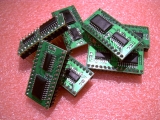
RFID Proximity Reader Module

 
It is ML042 - Proximity Card Access Control Module, an RFID modul that integrates several functions all together in one single instrument. The integration enables a proximity card reader for lock, access control or serial control into a module.

125 kHz embedded proximity card reader module.
Provides the functions of a proximity reader on a single integrated circuit.
With compact size (36.5mm x 18.5mm).
In standard 600 mil DIP-28 package, small enough for putting into your application.
Adapts easily into various enclosures.
Ideal for third party lock or reader manufacturers who integrate the module into their products.
Antennas and proximity cards are also available for your convenience.

Wednesday, December 05, 2007

RFID Implants

One company plans deeper implants that could vibrate, electroshock the implantee, broadcast a message, or serve as a microphone to transmit conversations. "Some folks might foolishly discount all of these downsides and futuristic nightmares since the tagging is proposed for criminals like rapists and murderers," Ms McIntyre said. "The rest of us could be next."

The chip implant is being presented as an advance over credit cards and smart cards, which, absent biometrics and appropriate safeguard technologies, are subject to theft, resulting in identity fraud.


Identity fraud costs the banking and financial industry some $48 billion a year, and consumers $5 billion, according to 2002 Federal Trade Commission estimates.


In his speech today at the ID World 2003 conference in Paris, France, Scott R. Silverman, CEO of Applied Digital Solutions, called the chip a "loss-proof solution" and said that the chip's "unique under-the-skin format" could be used for a variety of identification applications in the security and financial worlds.


The company will have to compete, though, with organizations using just a fingerprint scan for similar applications.


The ID World Conference, held yesterday and today at the Charles de Gaulle Hilton, focused on current and future applications of radio frequency identification (RFID) technologies, biometrics, smart cards and data collection.

Wednesday, October 31, 2007

Japan and Ubiquitous Network

Japanese society is among few countries in the world that highly aware with the benefits of information technology to society.

Recent development of Internet has showed that the next generation of Internet will be Ubiquitous Networks. In this era, everything will be connected each other using wireless sensor or what we called RFID right now.

According to ITU research paper, "Ubiquitous" has also become a term familiar to the average Japanese citizen. Even, twenty four percent of the Japanese population are aware of its meaning. Therefore we can assume that Japan will continue to be one of few countries in the world adopting next generation of Internet.

Monday, October 01, 2007

Simple RFID

An RFID tag is an object that can be stuck on or incorporated into a product, animal, or person for the purpose of identification using radiowaves.

Some tags can be read from several meters away and beyond the line of sight of the reader. Most RFID tags contain at least two parts. One is an integrated circuit for storing and processing information, modulating and demodulating a (RF) signal and perhaps other specialized functions. The second is an antenna for receiving and transmitting the signal.

A technology called chipless RFID allows for discrete identification of tags without an integrated circuit, thereby allowing tags to be printed directly onto assets at lower cost than traditional tags.

Wednesday, July 04, 2007

RFID in World Wide Industries


RFID is already in use all around us. Ever chipped your pet dog or cat with an ID tag? Or used an EZPass through a toll booth? Or paid for gas using ExxonMobils' SpeedPass? Then you've used RFID.

Some uses, especially those related to security, seem like a great idea. For instance, Delta is testing RFID on some flights, tagging 40,000 customer bags in order to reduce baggage loss and make it easier to route bags if customers change their flight plans.

Three seaport operators - who account for 70% of the world's port operations - agreed to deploy RFID tags to track the 17,000 containers that arrive each day at US ports. Currently, less than 2% are inspected. RFID tags will be used to track the containers and the employees handling them.

The United States Department of Defense is moving into RFID in order to trace military supply shipments. During the first Gulf War, the DOD made mistakes in its supply allocation. To streamline operations, the U.S. military has placed RFID tags on 270,000 cargo containers and tracks those shipments throughout 40 countries.

On a smaller level, but one that will instantly resonate with security pros, Star City Casino in Sydney, Australia placed RFID tags in 80,000 employee uniforms in order to put a stop to theft. The same idea would work well in corporate PCs, networking equipment, and handhelds.

In all of these cases, RFID use seems reasonable. It is non-intrusive, and it seems to balance security and privacy. Other uses for RFID, however, may be troublesome.

Friday, June 22, 2007

RFID in the Future: A Simple Prediction


This is a straightforward opinion regarding the future of RFID.
RFID (contactless or proximity chip) technology will probably be accepted in most industrialized nations on the basis of increased efficiency and personal security.
All but the most strenuous objections will be overcome by steps taken to ensure that individual privacy will be safeguarded.
This initial rollout of the technology will create economies of scale that will allow the chips and antennas to approach invisibility to the naked eye.
At that point, the chips will become ubiquitous -- they will be everywhere and used in many clever ways.
As it getting smaller and cheaper, it has big opportunities to be accepted world widely in industrial and business applications.
A generation or two from now, we will be living in the panopticon -- naked in a goldfish bowl. Does the prospect of this scenario bother you enough to write your congressperson in protest?

Wednesday, March 28, 2007

How RFID Works?


RFID taging technology is successfully used among us, but we don’t notice them always and do not think about them as they are not noticeable because we do not have directly to take any actions to transfer or read any information from RFID Tags. But probably everyone notices in big supermarkets, book stores two parallel frame antenas and thicker labels on products you buy, or maybe you have RFID entrance card at your work. The above figure shows how this technology works.

RFID is so called Radio Frequency Identification system which consists of two main parts: transmitter and receiver. The labels, access cards and even passports in some countries they have RFID transponders integrated. These transponders are called “tags”.

Tuesday, March 27, 2007

RFID Software 3.0 Developer's Guide

If you are interested in software related RFID applications, Sun Java System is a good solution for RFID developer aroun the world.

Sun Java System RFID Software 3.0 Developer's Guide

It provides free materials for developers to exploit RFID technology as a core ubiquitous networks for future Next Generation Internet.

The contents is as follows :

Before You Begin

Before You Read This Book

Documentation Formatting Conventions

General Conventions

Typographic Conventions

Related Documentation

Sun Welcomes Your Comments

1. Introduction to Sun Java System RFID Software Programming Platform

RFID Software Architecture Overview

Structure of a Configuration Object

RFID Event Processing Basics

Identifier Objects

Event Objects

Processing RFID Event Manager Information

Managing RFID Event Manager Devices

2. Creating Custom Filters and Connectors

Setting Up Your NetBeans Environment

procedure iconsmall spaceTo Download and Install NetBeans

procedure iconsmall spaceTo Download and Install the RFID Software Toolkit

procedure iconsmall spaceTo Set Up the Example Filter Project

procedure iconsmall spaceTo Create the RFID Library for the Custom Component Examples

procedure iconsmall spaceTo Build and Test the Sample Filter Project

Creating a Custom Filter

Understanding the Sample EPCTypeFilter

procedure iconsmall spaceTo Customize the Sample Filter

procedure iconsmall space To Compile the Customized Filter

Using the Filter Template JUnit Test

procedure iconsmall spaceTo Modify and Run the JUnit Test

Integrating Custom Components With the RFID Event Manager

procedure iconsmall spaceTo Add the EPCTypeFilter Custom Filter to the Demo Configuration Object

Creating a Custom Connector

procedure iconsmall spaceTo Create a Sample Connector Project

3. Using RFID Device Client APIs

Implementation of the ReaderClient API

Reader Client Constructor Parameters

EMSEventListener

ReaderClient API Reference

Building a Sample Reader Client Program

procedure iconsmall spaceTo Set Up the Sample Reader Client Environment

procedure iconsmall spaceTo Run the Sample Reader Client Program

Explaining the Sample Reader Client

Implementation of the PrinterClient API

PrinterClient API Reference

Building a Sample Printer Client

procedure iconsmall spaceTo Set Up the Sample Printer Client Environment

procedure iconsmall spaceTo Run the Sample Printer Client Program

Explaining the Sample Printer Client

4. Using Web Services for Device Access

Overview of Web Services for Device Access

Web Services Interface Reference

Web Services for Reader Access Java Interface

Web Services for Printer Access Java Interface

Creating and Running the Web Services for a Device Access Client

Prerequisites for Running the Web Services Client Examples

procedure iconsmall space(Optional) To Access the NetBeans IDE 4.1 Quick Start Guide for Web Services

procedure iconsmall spaceTo Configure the Environment for the Web Services Client Examples

Writing the Static Web Services Client

procedure iconsmall spaceTo Run the Static Web Services Client Example

Writing the Dynamic Web Services Client Example

procedure iconsmall spaceTo Run the Dynamic Web Services Client

5. ALE Web Services

Broad Architecture

ALE Service Architecture

Other Considerations

Using ALE Web Services Client (ALEClient) API

Client Checklist

procedure iconsmall spaceTo Set Up the ALE Client Environment

procedure iconsmall spaceTo Run the ALE Web Services Client

Troubleshooting for ALE Client

6. Using RFID Information Server Client API

Architecture

Database Tables

Connecting to RFID Information Server

Exchanging Data With RFID Information Server

Modifying RFID Information Server Tables

Using Table Request Objects

Using the Update/Delete/Query Request Object

Querying RFID Information Server Database Tables

Processing RFID Information Server Responses

Handling Exceptions

How to Catch an EPCISException Error

How to Throw an EPCISException Error

7. PML Utilities

Introduction

Capturing Tag Observations Using PML Core

PML Utilities Packages

PML Core Package

PML Parser Package

Class Path Requirements

UML Class Diagram For PML Package

Monday, March 26, 2007

This is the good way to download the Internet


Check this picture, this is a nice visual description on how to download "the Internet"...
Thank's to geeks at double u three schools dot com, you have a high value of humor...

Friday, February 23, 2007

Australian Doctoral Theses Collection

I've just found a useful site contains many PhD works in all Aussie's Universitis, it's called "Ausralian Digital Theses Program".
The aim of the ADT program is to establish a distributed database of digital versions of theses produced by the postgraduate research students at Australian universities.
The theses will be available worldwide via the web. The ideal behind the program is to provide access to, and promote Australian research to the international community.
When Indonesian could provide such facilities to the world ???

Sunday, January 07, 2007

My First Notes in 2007

Dear all,

Alhamdulillah, we are still met by Allah in this year, although some of us maybe leaved by beloved one, like me (my lovely mother, allahum maghfirlaha war hamha wa afiha wa'fu'anha).
By the way, the twins are now 1.5 years. So funny twins... this morning before I went to campus, my wife, my sister in law and me taked the kids bath ourside the house, they played water with laughing experessing their happiness with little jumps...
All right, that's all mates :)